Maintenance & upkeep
Scheduled maintenance to manufacturer specifications, including wear inspection, lubricant changes and functional testing.
With us, the condition and performance of your wind turbine stay permanently in view – reliable, documented and on schedule.
We maintain and optimise wind farms as well as individual turbines – from scheduled maintenance to short-notice troubleshooting.
Scheduled maintenance to manufacturer specifications, including wear inspection, lubricant changes and functional testing.
Fault finding and repair of electrical, hydraulic and mechanical components – fast and clearly documented.
Upgrades and retrofit measures that increase the availability and yield of your turbine.
We are a young team working sustainably on wind turbines for a clean future. Our focus is on maintenance and service work on Vestas turbines.
Maintaining wind turbines is not only a matter of safety and efficiency – it is also mandatory. Legislators, insurers and the German employers' liability insurance associations require recurring inspections of wind turbines.
As an owner-managed company from Mecklenburg-Western Pomerania, we work with short lines of communication, permanent contacts and clean documentation of every job.
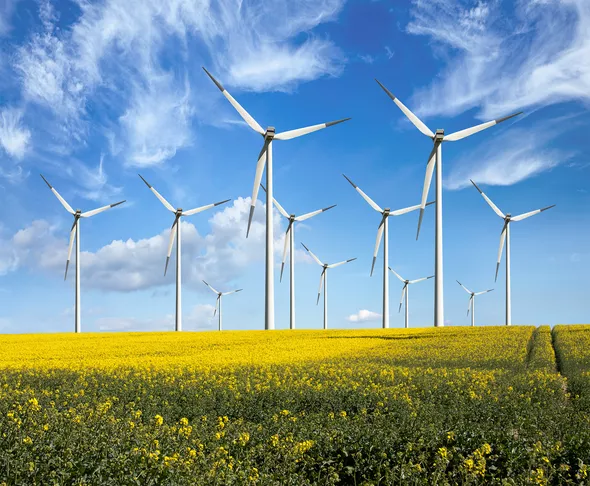
Originally, windmills were used to pump water and turn grain into flour. Today, however, they are used almost exclusively to generate electricity.
The power of the wind turns the rotor, which consists of individual blades; its kinetic energy drives the wind turbine and generates electricity in modern windmills.
The basic principle has not changed since early human civilisation. But as the need to grind grain developed into the need to generate electricity, new parts were introduced: turbines made up of gearboxes and generators. This technology continues to be developed. Windmills can now be found on every continent and contribute a considerable share of the global energy supply.
Source: History of Wind Turbines, Renewable Energy World, 21 November 2014.
Wind turbines are one part of the windmill, not an entirely separate machine. Modern wind turbines are the part of the windmill that actually generates electricity.
The turbine blades are attached to the rotor, which turns the components at the core of the windmill. Electricity is generated through the gearbox and generator as soon as the blades rotate.
Source: Renewable Energy World, 21 November 2014.
Wind power is essentially electricity generated by the rotation of turbine blades in the nacelle at the top of the windmill tower. It is one of the most widely used forms of clean energy.
Unlike fossil fuels, wind power produces no CO₂ emissions during operation and therefore has a positive effect on the environment. Wind has become a leading form of commercial and private energy supply.
Source: Renewable Energy World, 21 November 2014.
Wind power works in a similar way to other turbine-based generation methods such as hydropower or nuclear power. All three generate electricity from the kinetic energy of turbine blades, which is then transported via transmission lines.
The difference: wind uses the force of the surrounding air, while hydropower and nuclear power use water and steam respectively. Wind energy technologies have improved steadily over time – both the electricity generated and the installed capacity have grown considerably in recent decades and will continue to grow.
Source: Renewable Energy World, 21 November 2014.
Give us a call – we will discuss your requirements directly and without red tape.